Showing posts with label Operation. Show all posts

08 April 2022

The MasterKeyer MK-1 by N0XAS


The MasterKeyer MK-1 breaks new ground in ease of operation. 

Six multi-color, LED illuminated pushbuttons give instant access to stored messages any of five banks -- that's 30 messages in all, for over 7500 total characters. The LED-backlit buttons change color to tell you whether a message is being sent or recorded. A large, smooth operating, solid aluminum speed control knob can be used to set your operating speed within whatever range you decide. The smooth, sine-wave sidetone lets you hear what you're doing at all times. Of course it can be muted, or turned up for room-filling sound ideal for code training and practice sessions. And commands to change options and messages can be sent from your paddle, or plug into your computer for easy, text-based setup!
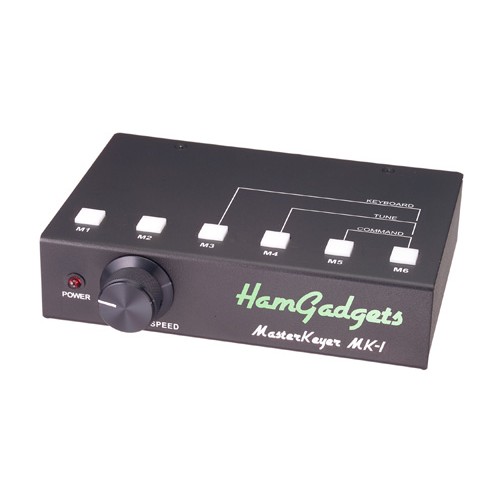

The latest low-power embedded microcontroller technology is used to give you the features you want, with the ease of operation you need. Advanced operating modes such as message pause, auto-repeat (beacon), QRSS and HSCW are a snap -- and with future firmware upgrades, even more features are just a quick (and free) upgrade away!

Of course the MasterKeyer can be used as a top-quality, fully featured stand-alone keyer, with no computer or keyboard required. All the operating features you expect, and some you may not, are built in and ready to use. The built-in USB capability can add a whole new dimension to your operating! The USB host connector -- the only one on any keyer, anywhere -- can be used to load new updates directly from a USB FLASH drive, without using a computer. You can also save all operating parameters and memory contents to a FLASH drive, so you don't risk accidentally losing your settings. Edit the simple text file if you wish to suit your exact needs. The ability to save and load the entire configuration makes this keyer perfect for clubs and contest stations! If multiple operators use the same keyer, just plug in a FLASH drive and load ALL your own settings and memory messages in seconds. Of course, the same feature can be used to "clone" your settings from one keyer to another if you need stations set up the exact same way.

This keyer is presently offered only in fully assembled and tested form. The enclosure is top quality, rugged aluminum with a textured black powder coat finish. Silkscreened legends mark all operating controls and connections. All documentation is on a CD-ROM, as well as software drivers for Windows PCs (drivers are already built into Mac and Linux systems). A power cable is included to connect to your power source.


Features

Beautiful metal cabinet with rugged, textured powder coat finish and screen printed legends

Knurled, gloss finish solid machined aluminum speed adjustment knob with indicator line

Meets FCC Class B limits for radiated and conducted emissions

Morse code keying from a single or dual lever paddle

Straight key input for manual keying

Emulation mode for K1EL Winkeyer commands has been added to Version 1.20 and newer. The MK-1 now works with a wide range of logging and contest software. If it supports the Winkeyer, the MK-1 will work fine.

Support for Morse from a USB keyboard! Includes memory record & playback.

Optically isolated Keying and amplifier/PTT outputs rated for 400V at up to 200 mA (Key Out) or 400 mA (Amp Out) - key solid state or tube rigs!

Amp keying lead and tail times adjustable

Smooth sidetone with easy-to-use external volume control can be muted or left on

Numerous keying modes supported

Curtis Mode A

Curtis Mode B (with adjustable paddle timing)

“Bug” mode – automatic dots, manual dashes

Ultimatic mode

Straight key or “Cootie” mode

Dot or dash priority


Adjustable paddle timing lets you "tweak" the paddle response to suit YOUR preference!

Thirty memory slots available in five banks of six messages each

Each message can be up to 255 characters in length

Any bank of 6 messages can be assigned to the top buttons

Embedded commands in memory messages for a wide range of functions

Send your stored callsign

Send serial/QSO number, with or without automatic incrementing

Send a steady carrier 1-9 seconds in length

Increment or decrement speed by 1 WPM

Set your speed to a specific value

Send HSCW at up to 12,000 LPM (2,400 WPM)

Send QRSS from 1 to 120 seconds per dit

Set Farnsworth spacing

Send the last call sign (other than your own) sent from the paddles

Call any other message from any bank

Merge two characters into one for prosigns or language specific characters

Message stacking lets you quickly send up to six messages in sequence

Messages can be paused to manually insert information from the paddle or keyboard, and will automatically resume

Beacon mode will repeat a message at regular intervals from 1 to 255 seconds - Now with V1.20 or later, each message can have its repeat time set independently!

“Cut numbers” supported for serial numbers (0, 9 or both)

Altered settings (Farnsworth, QRSS, HSCW) automatically cancel on completion of the memory message

Simple, intuitive memory record/play control

Tap any memory button to play its associated message

Hold the button to review, record or edit the message

Optionally, you can edit messages from your PC!

Two USB interfaces

Review or change any setting from your computer

Review, change and save memory messages

Save and load complete configuration - multiple ops can instantly load ALL their own settings and messages!

Upgrade firmware and add features in seconds - no need to return the unit or even open the case!

“Dual-Set” speed control allows easy default to a pre-set speed

Separate, fixed user interface (Command Mode) speed setting

Adjustable sidetone monitor frequency and volume

“Stuck key” safety disables keyer if a stuck paddle is detected

Smart tune mode with constant carrier or 50% duty cycle

User adjustable speed control range (5-99 WPM); you set the lower and upper limits

Farnsworth spacing is supported

Automatic letter spacing is supported

HSCW at up to 12,000 LPM (2,400 WPM)

QRSS settings from 1 to 120 seconds per dit (QRSS1 – QRSS120)

Power from any AC or DC source from 9 to 20V

Built-in self resetting overcurrent protection


The firmware that controls the operation of the MasterKeyer MK-1 is under constant review and revision. New features are often added to keep the MasterKeyer at the leading edge of technology. Version 1.32 is the current released version.

MK-1 Manual V1.30 or higher:

MK-1 Firmware V1.32:


73 - Petr, OK1RP

07 April 2022

Easitalk™ - Advanced and innovative DSP noise reduction feature by Codan

Easitalk

Easitalk (easytalk) is a feature of NGT transceivers that removes noise and interference from incoming voice signals. Easitalk works by applying Digital Signal Processing (DSP) techniques to incoming voice signals. These techniques are similar to those used with digital mobile telephones and satellite telephones.

Easitalk is simple to use because it is integrated into the transceiver - it is not in a separate unit. No tuning is required, just an on/off control.

Listening trials indicate that Easitalk outperforms other noise reduction products, and it has been successfully trialled with a wide range of languages.

By integrating speech processing within the transceiver, Codan has not only made speech processing more effective but, more importantly, has made it useful in the hands of the user. For the first time, mobile users will now be able to enjoy the benefits of noise reduction technology.

Hear the difference ... The same transmission was received by two HF tranceivers, one with Easitalk enabled and the other, without. Both transceivers were connected to the same antenna.


No Easitalk


This is typical HF radio containing both voice and a large amount of background noise. The average signal (shown as a lighter colour) is fairly even indicating that the voice signal is not any more prominent than the background noise.


Codan advanced DSP noise reduction (Easitalk
)

Easitalk has removed much of the background noise and the average signal (shown as a lighter colour) displays a form much more like a voice waveform with highs and lows.


Does Easitalk offer any benefits over Lincompex? 

Yes. In networks that use Lincompex (LINk COMPression and EXpansion), each system in the network needs to be equipped with Lincompex software. With NGT, a single transmitter with Easitalk can be used within a network and still be able to communicate with other systems, but those systems won’t benefit from the features of Easitalk. 

For a continuous signal, Lincompex provides no discernible improvement over any other compression scheme. During inter–word quiet periods, the Lincompex receiver effectively prevents background noise levels from rising (this provides Lincompex’s apparent improvement). During continuous or substantially continuous speech, no improvement is noted. 

Under poor conditions, interfering signals may distort the recovered Lincompex control signal. Under very poor conditions the control signal cannot be properly decoded and the signal recovery mechanism breaks down completely. 


73 - Petr, OK1RP

27 July 2021

RGO One - New firmware version 2.34A released


New firmware version 2.34A is released

A new version of the firmware is ready to download here

Improvements are in the front panel microprocessor and includes the following:


  1. Start up issue completely resolved. On some bands and frequency segments RGO ONE can not initialize properly LO chip SI-570 on power on. So the radio is deaf on RX and there is no transmission at all. If UP or DOWN buttons are cycled everything goes fine. This new FW completely removes this problem.
  2. Internal serial I2C bus speed is set to 200kbps. All daughter board including LO board communicate with FP processor via this interface. Signals – SDA1 and multiplexed clocks SCL11-SCL18
  3. Out of band operation issue resolved when in SPLIT mode
  4. QSY to another band issue resolved. When using main dial to change the frequency to another band or when change the frequency via CAT – RGO ONE can not transmit although tuned frequency is within HAM assigned bands . The radio worked only if UP or DOWN buttons are depressed.

10 April 2021

Latest fw revision 2.20A for RGO ONE is now available

Hello,

latest firmware revision is available to upload on your RGO ONE transceiver. 


https://lz2jr.com/blog/index.php/new-firmware-2-20a-available/

This version includes some improvements in MB and FP microprocessors clock rate, speed and correct timing.
Setting proper clock rate for MB processor. (Clock frequency away from HAM bands). Main board microprocessor clock can be heard near 20m band (actually image signal) like “crackling wideband noise”. With this version MB clock rate is adjusted little lower so not to disturb 20m reception.
Added MENU 81 – FCAL2 correction coefficient (coarse calibration) for SI570 VCO chip. If your RGO ONE is calibrated without FCAL2 then parameter value of MENU 81 would be zero.
Low pass filters (LPF) in PA module now are switched only on TX and disabled on RX. This is part of a LARGE SIGNAL HANDLING MOD.
Along with added pull down resistor in LPF board, this mod significantly improves RX dynamic range and LW/MW BCI immunity.

FW 2.20A highlights:

  1. Improved communication between transceiver and PC at low CAT speeds.
  2. Resolved CW sidetone issue (sidetone punctuation) when CAT system is activated.
  3. “Crackling”noise issue resolved by slightly reducing of MB microprocessor clock frequency (set at 31.800 MHz)
  4. Meter display now predicts/ shows measure mode – SWR, RF, ALC. Default mode is RF on TX.
  5. LCD icons for otional modules do not show up if corresponding optional board is not installed.
  6. Internal keyer CW speed/ratio corrected
  7. UP/DWN/FST buttons on mic now are active.
  8. Service menu entry added – menu 81 FCAL2 – SI570 calibration correction coefficient.
  9. LPF and dedicated filter on TX is switched only on TX and disabled on RX. This helps to improve large signal handling at receiver front end. (This is part of LARGE SIG HANDLING mod).

07 January 2020

The ATU add-on module for RGO ONE is coming soon

Hi all,

as you know the optional module of ATU is under finishing and the f/w code under tweaking for the RGO ONE.


One of the hardest point of the ATU performance - the very low impedance matching has been successfully tested on the beta test piece of RGO.

Look over here: https://youtu.be/aImge42dZZk

The antenna in use was an 80m band dipole. Tested band was 160m.
The ATU f/w code is still under tweaking and hardware is in beta testing to be sure that all will perform excellently in RGO ONE.


73 - Petr, OK1RP

The RGO ONE pre-order form online available now

Hi folks,

Due to the high volume of inquiries recently received Boris, LZ2JR decided to post this google form which reserves the right to the user who filled in this form to get advantage ordering RGO ONE transceiver on “first come – first serve” basis. Please FILL IN and SUBMIT the form as soon as possible.

The link is added to the Boris, LZ2JR page as same as to home page description of the RGO groups.io.

You can place the pre-order anytime online here:
https://docs.google.com/forms/d/e/1...nolpgclHW2n0XccpyeMI2vCA/viewform?usp=sf_link

Also directly on Boris, LZ2JR page here:
http://lz2jr.com/blog/index.php/rgo-one-preorder-form/


73 - Petr, OK1RP

06 December 2019

RGO ONE - new classic CW / SSB transceiver on the market - part 3 (first impression)

Hi all,

I got the chance to test this new radio coming on the market these days. Last evening I found the time to bring the RGO ONE to our contest station in order to make first short test on the air.

I have to say that I am impressed how the receiver is quiet. Compare to other radios and mainly SDR architecture radios the RGO ONE receiver has smooth and low noise. The VBF is very effective and nice feature for close in signals.

I had only short time yesterday evening so I tested it quickly on 40m then 80m band. As I found the pile-up for T6AA on 80m I had chance also to testing the RIT/XIT features etc. It is easy to manage and operate the RIT/XIT on RGO ONE.


Big surprise came after switching to 40m where that nite was hearable OTHR intruder at around 7005kHz. I tried to switch antenna to our contesting Icom IC-756PROIII quickly to found that OTHR occupied most of the CW portion in 40m band with over S9+20dB wideband mess. Even with 500Hz filter on Icom I was not able to hear any signals on 40m CW band as 30kHz far from the center I still had S8 wideband noise.


After switching to RGO ONE the surprise happened. Of course the OTHR blasted to S9+30dB at 7005kHz and covered wide portion of CW band but when I switched the VBF ON and reduced it down to 200Hz then I noticed that when I tuned up over the 7015kHz the wideband mess gone and I was able to operate and make QSO without any problem or QRM. Amazing!


I did not make video unfortunately as my phone battery lasted exactly at that time when I need it, hi... but I made QSO 15kHz away from the OTHR intruder with VBF set to 300Hz and I was not disturbed at all...

I had no more time to test it yesterday evening so more tests will come later.


And one more think... I like very much the sentences posted by KW6LA:
"I do like the old style controls. RGO ONE looks like a radio, not a garage door opener!"


73 - Petr, OK1RP

RGO ONE - new classic CW / SSB transceiver on the market - part 2

RGO ONE is the GOLDEN classic super-heterodyne down conversion HAM transceiver covering all HF bands 1.8 - 29.7MHz (160/60m as an option).

High dynamic range receiver design including high IP3 monolithic linear amplifiers in the front end and H-mode first IF mixer.
Low phase noise first LO – SI570 XO/VCXO chip.

Full/semi (delay) QSK on CW using click-less quiet diodes switching; PTT/VOX operation on SSB. Strict RX/TX sequencing scheme. No click sounds at all!

Due to its modular construction it can be easily modified or redesigned in manner that suits operator. This kit is intended for users that like building their own home made equipment and constructions.


Main goals

  • Classic super-heterodyne design – with popular 9MHz intermediate frequency. Filter method DSB to SSB modulation
  • Coverage of the 9 HAM HF bands (160m optional)
  • High dynamic range receiver design including high IP3 monolithic IC in the front end and H-mode first IF mixer
  • Fast acting IF (134kHz) AGC.
  • Click-less operation – solid state Ga-As PHEMT SPDT switches on RX, (band-pass filters; TX/RX) and ultra fast rectifier diodes (LPF)
  • Custom multicolor FSTN LCD (Especially developed for this project)
  • Custom made ABS face plate, unique and ergonomic knob controls
  • Custom made crystal filters – 6,8 pole, CF=9MHz, 2.8kHz, 2.7kHz, 1kHz, 500Hz
  • Three filters can be used - First IF roofer 8-poles 9MHz; second (optional) 4-poles variable bandwidth filter Johnson type 9MHz; third 2-poles noise filter 9MHz
 
 
  • Double CPU circuitry control for front panel and mother board, both field programmable via implemented USB hub
  • Modular construction with no “flying wires” inside the box. Transceiver is built up on a main – mother board which has two functions. First to serve as a “chassis” and second to fit all the external connectors, daughter boards, inter-connections and acts as cable harness.
  • Plenty of optional modules: Audio filters, Automatic antenna tuner (ATU), Noise blanker (NB), narrow/wide band IF crystal filters.
  • Linear final amplifier PA 50W with precise power adjustment especially for QRP operations. Forget noisy FANs – 25W  – unlimited time!! QRO work – with max power of 50W driving should be sufficient for a kilowatt amplifier.

 
  • Personal computer control CAT via USB
  • Morse code keyer (Curtis A, CMOS B)
  • Contest and DX-pedition operation conveniences
  • Both Kit & Ready-to-Run versions will be available


And one more think... I like very much the sentences posted by KW6LA:
"I do like the old style controls. RGO ONE looks like a radio, not a garage door opener!"


73 - Petr, OK1RP

RGO ONE - new classic CW / SSB transceiver on the market - part 1

Hi all,

This coming new CW/SSB all HF bands transceiver is the “classic” architecture of 9MHz IF super-heterodyne with good filtered front-end and proper roofing crystal IF filters.
It is using PHEMT LNA, high dynamic range H-mode mixer, 8+4 poles crystal filters etc.
Full, fast and absolute quiet QSK with proper timing is devoted to all CW enthusiasts.
It looks like great era of famous TenTec transceivers is coming back :)


http://lz2jr.com/blog/
https://groups.io/g/RGO-ONE
https://www.eham.net/reviews/view-product?id=14445


Experiences with RGO ONE in CQWW, CW by John, AE5X:https://ae5x.blogspot.com/2019/11/cqww-cw-with-rgo-one.html

Some pics of my new arrived RGO ONE are uploaded in groups.io here:https://groups.io/g/RGO-ONE/album?id=223623


And one more think... I like very much the sentences posted by KW6LA:
"I do like the old style controls. RGO ONE looks like a radio, not a garage door opener!"


73 - Petr, OK1RP
.../-.-

01 July 2019

Sea of Peace Award 2019 (SOP) started!

Sea of Peace Award 2019 (SOP) started!
 
If you want to get beautiful pennon or following your last year achievement you would like to continue to get sticker then you should turn on your radio and pay attention to the stations from the required countries during the July 2019...

This certificate in form of a silk pennon will be awarded for QSOs with the Baltic neighbouring states and regions in July. Annual stickers can be acquired for repeated fulfilment of the rules during the subsequent years.


Beyond coming SOP-owners will receive special recognitions after 5-and 10-times achievements of the pennon and stickers.


This popular certificate was awarded by the amateur radio organisation of the former GDR in 1958. And has been continuing by the DARC district Mecklenburg-West Pomerania since 1991.
 
The DARC district Mecklenburg-West Pomerania publishes this honouring since 1991 to all licensed radio amateurs and SWLs, in the time from the 01.07., 00.00 UTC, to 31.July, 23.59 UTC per year, who fullfilled the following rules:
     EU   -  applicants: 15 points, of it 3-DL points
     DX   -  applicants: 10 points, of it 1-DL points
     VHF - applicants: 
5 points, DL points are not necessary
Points:A QSO with a station from the DARC district Mecklenburg-West Pomerania
(DOK  Vxx  additional Z87, Z89, MCM, MVP, SOP, YLV) counts 3 points, all other German stations (max. 3 stations) and stations each once one pouint.
QSOs with stations in the following countries and districts count in each case once one point.

ESLALYOHØOH1OH2OH5OH6 OH8OH9OJØOZ 
R1R2FSMØSM1SM2SM3SM5SM6SM7 SP1SP2 YL  
There are no band- and modes of restrictions. Beginning in 1992 SOP sticker (small pennons) are published for renewed fulfilling of the conditions. The SOP pennon is pentagonal and multicolored; 22 cm wide and 33 cm long. The sticker about 7 cm wide and 10 cm long. As a bonus after 5-times achievement of the SOPs the applicant receives a special sticker (free of charge), after 10 years achievement a certificate.
Supplement for 2019: Foreign stations with the suffix "SOP" (e.g., OZ4SOP, SJ1SOP...) count as a joker for a not achieved area if they are activated in the current year...

Application:
Log extract - please till 31 August every years - Calls alphanumerically listed
Manager: Georg Tretow - DL4SVA, P. O. Box 1114, D-23931 Grevesmühlen, email: DL4SVA@darc.de
Fee :  SOP pennon  DL 12 Euros, non DL 15 Euros, SOP Sticker 5 Euros

The manager sends an email with the account data.

On-line applications are preferred.

https://ok1rp.blogspot.com/2018/07/sea-of-peace-award-2018-sop-started.html
http://www.dl0sop.darc.de/Seite-2e.htm
https://www.amateurfunk-mvp.de/sop-antrag/index.php


73 - Petr, OK1RP


29 November 2018

Looking for clean SS HF PA w/QSK - part 6 (Russian Burst-2000A)

Hi all,

Thanks to www.cqdx.ru we can see very first general specification of the new LDMOS HF PA which is rated at 2.2kW output thru all HF bands up to 50MHz:

http://www.cqdx.ru/ham/qro-qrp/burst-2000a-ldmos-power-amplifier/?utm_campaign=shareaholic&utm_medium=google_plus&utm_source=socialnetwork

As you know my preview parts talked about:
SPE EXPERT 1.3K-FA
ACOM 1200S
JUMA PA1000
LINEAR Amp Gemini HF-1K

Azden AZR-1000

Elecraft KPA1500

The Burst-2000A is using water cooling system and it is promising all possible protections which could be implemented.

An interesting think is the exciting power just 15W only to get full power of 2.2kW and full automatic switching system.


Unfortunately it looks like there is no ATU inside and mainly there is nothing said about the T/R system used in the amplifier. So we can doubt if this LDMOS PA has full, fast and silent QSK implemented.

So we will have to wait until more information will be published...


73 - Petr, OK1RP
"auf die Dauer hilft nur Power" (Erich, HB9FIH)


25 July 2018

VHF / UHF Field Day 2018 from 220m ASL QTH...

Hello,

so the VHF / UHF Field Day 2018 is finished.

I participated in the contest with son Jakub from OK5T contest QTH together with the rest of the team. In summary it was nice weekend with lot of very enjoying QSOs on 2m and mainly on 70cm... even although this QTH is only 220m ASL.

Any kind of QSO on 70cm is challenge from this QTH, hi...

The only 100W transceiver in small pistols category using the 1x LFA (G0KSC) antenna this year at the 220m ASL is not predestined to win on 2m. On the other hand I have to say it worked well thanks to good condx and mainly thanks to an excellent antenna!


At the beginning IQ5NN (774km) station came with nice sigs so Ludek, OK1VSL was pleased to start first hour of the contest with nice DX.


Everything worked well all the time including the second operating position for 70cm band where Jakub, OK1-36357 aka OK1RCG spent maximum time and his effort in order to try what is possible with installed setup and low profile, low ASL QTH and tried to get as best result as possible.


The current club's 70cm setup is using 20W from FT-857D (many thanks to Mira, OK1JMJ) into small 14el. single yagi, so it is hard job to get some reasonable results over there...


The only interesting thing was at the beginning of the contest that most of the sigs had very fast QSB and lot of calling stations disappeared during first shot.
 
The most important time for me was Sat/Sun night when I planned some DX-ing on CW. It was a bit dissapointing for me but even although I expected a bit more from this part time I worked stations over 500km away on 2m and some stations over 400km on 70cm band.


The assembling the 70cm station in the car was funny and Ludek, OK1VSL had to make light gymnastic figures, hi...


My son Jakub enjoyed his "Scouts" VHF Field Day part on 2m as OK1KDG where he made a bit lower result refer to last year probably also thanks to single LFA only compare to last year.


We enjoyed the sunshine WX with hot temp over 30C deg and sausage BB in the Sat evenning so it was enjoyable weekend for all the team I hope.


Finally we worked 93 QSOs with over 18k points on 70cm in VHF/UHF Field Day this year using only 20W out into 14el. single Yagi as OK5T mainly thanks to Jakub! Well it is the best club's result with this setup from our 220m ASL QTH...


Also some paddles and keyers were tested Sun morning by all club's mates so we enjoyed the CW not only on the air, hi.


Even executive director and club's cheef Ludek, OK1VSL "itself" played with my Hex key from Bencher a bit under precise supervision by top-class telegraphist Lada, OK1DGU (on the right)...


Many thanks for all nice QSOs during the enjoyable weekend and hope to hear you again on the air soon.

http://www.ok5t.cz/
"Scouts" VHF Field Day claimed score:
https://groups.io/g/ok-on-air/attachment/704/1/Claimed_score_%20PDM_2018.pdf
Scouts VHF Field Day final results 2018:
http://www.ok2kkw.com/next/pdm2018.pdf


73 - Petr, OK1RP
.../-.-

