02 August 2016

What's up in space these days

Hi all,
 
if you are interesting in the DX conditions or bands propagations seriously then it is really important to know what's up in space in general...

GEOMAGNETIC STORM WARNING: NOAA forecasters estimate a 65% chance of geomagnetic storms on Aug 2nd when a CME is expected to strike Earth's magnetic field. A solar wind stream following close on the heels of the CME could boost storm levels to G2 (moderately strong). High latitude sky watchers should be alert for auroras.

Scientists classify solar flares according to their x-ray brightness in the wavelength range 1 to 8 Angstroms. There are 3 categories: X-class flares are big; they are major events that can trigger planet-wide radio blackouts and long-lasting radiation storms. M-class flares are medium-sized; they can cause brief radio blackouts that affect Earth's polar regions. Minor radiation storms sometimes follow an M-class flare. Compared to X- and M-class events, C-class flares are small with few noticeable consequences here on Earth.

Visit:
http://spaceweather.com for updates and more information.
 
 
73 - Petr, OK1RP

23 May 2016

Replacing an output amplifier chip in RigExpert AA-200 antenna analyzer

Hi all,

after some unsuccessful trials of repairing the AA-500 antenna analyzer from RigExpert by my good friend he decided to ask me to help him with that job last month.

As the local  (my affiliated) radio-club's analyzer AA-200 has been also damaged some time ago and I was asked to repair it and as I had to replace the same output amplifier in my own AA-200 analyzer 6 months ago I decided to make short guide and share it over here in order to help to other RigExpert analyzer users...

This article describes how to replace the Sirenza SGA-6589 output amplifier chip if the analyzer stopped working suddenly. The first symptoms are when the SWR is near 1 on all frequencies with any load. Also the flat frequency response with high noise thru wide range with no resonances or peaks during antennas tests. The Meter test mode does not show filled bars...


If the Sirenza amplifier is damaged then there are no scale deflections on both tests even does not matter if you have the test port loaded or keep it opened.

At first you need to prepare the ESD protected bench with grounded wristband (thru 1.5MOhms resistor) and ESD mat.


The best solution is to use two layers, oil, grease and solvent resistant, high temp resistant, acid proof and knife cut proof material with excellent wear hardness. These ESD rubber mats have two layers: the top one is a static dissipative rubber layer laminated to a black conductive rubber bottom layer. Surface resistance of the top layer is 10^6 – 10^8 Ohms and bottom layer is 10^5 – 10^6 Ohms.
 
These ESD rubber material offers excellent resistance to oil, grease and most common solvent:

http://www.ebay.com/itm/231949688420?ssPageName=STRK:MESELX:IT&_trksid=p3984.m1558.l2649

After that you can start to push the lock on the back of the tester. Pull-off the battery pack and remove the 6pcs of screws from the back cover of the analyzer.

 
After the removing of all 6pcs of the screws you need to separate the covers very carefully because you need to remove the flat ribbon keyboard connector cable first before the removing the front cover completely.


When you are finished and the front keyboard cover is removed then you can start to unscrewing the screws to remove the CPU board.


Be careful as you need to remove the grey bottom panel (on the right side of the picture) and remove the CPU board at the same time with disconnecting the another connector on the bottom of CPU board.


It is a bit tricky but definitely not difficult. You need only to be careful and watch what you are doing... Do not use too much force just slowly and carefully pull-up the board.

Note: The CPU board is long and held by its connector in the middle of the board together with RF detector unit. Do not pull-up the CPU board on the sides BUT in the center of the CPU board close to the connector. You will avoid the stressing the board and bending it.


This is what you will see after removing the CPU board out. Remove the isolating foam and start to removing the 4 screws on the RF detector board.


After removing the 4 screws you are ready to separate the RF detector board from the back cover finally. You should pull it out a bit to the right side and then up in order to safely removing the board with its metal panel (supporting the PL-259 test port connector) from the plastic back cover frame.


Rotate the RF detector board and you can find the Sirenza SGA-6589 to be replaced.

Unfortunately in case of the unit from our club I found (except the messy amplifier place) also a bit strange damage close to dead amplifier. As you can see there is also unstuck track to L6 inductor which makes the band pass filter.


The assembly microscope Mantis Compact from Vision Engineering will help a lot in that case to repair it...


I am going to remove L6 damaged inductor and repair the lost track. It will be cleaned then refurbished the track and inductor will be replaced by Matsushita wire wounded ceramic inductor with 47nH.


The damaged L6 inductor removed and the track is back on its place. Now the residual solder need to be removed and place need to be carefully cleaned from the flux etc.
 
 
The L6 removed and to be replaced with Matsushita Corp. inductor 47nH.
 
After that we can revert back to the SGA-6589 amplifier itself...
 

The professional de-soldering SMD UNIT 60A from ERSA will be used in my case.


It is very important picture. Please give attention to the amplifier package pads/pins. The pin in the middle is soldered on the both sides! You need to heat up the both sides > in that case all 4 pads together at the same time in order to safely and quickly remove the chip from the PCB. Only in that case you will not overheat the PCB!

Note: If you have not the professional tools or at least the de-soldering unit or heating unit (hot-air de-soldering station) then ask someone around you to help you. Do NOT try to heat up the pins step by step. You will not remove the chip and you will be in risk to overheating the PCB! Avoid the strange mess around the chip and damaging your PCB in analyzer.

After removing the Sirenza chip the place need to be cleaned also from the residual solder and fluxes.


It looks better isn't it? :)

Now we are going to soldering new Sirenza SGA-6589 to the PCB and in my case also the L6 inductor as part of the band pass filter replacement.


New ceramic wire wounded inductor found. After checking it on the Agilent Precision E4980A RLC Meter it can be soldered on the PCB as same as the Sirenza SGA-6589 amplifier.


If you are not experienced with the SMD soldering then put small piece of iron to the single pad. Using the tweezer or much better sticky pen:

http://kitman.eprodavac.cz/adhezivni-smd-pero-stickypen-70/ 

... hold the chip on its place and heat up the pad with piece of iron.


You have chip safely on the right place (you can heat quickly again in order to move a bit if needed) and then you can peacefully soldering all other pins/pads with small amount of iron and heat up it properly but quickly.


Do not use a lot of iron. It is not necessary and you have better control about the proper soldering and heating thru the pads/pins.

After finishing the soldering of Sirenza amplifier and cleaning the flux around if needed you can start to assembly the analyzer in reverse procedure step by step.

If you are done you should not have any kind of screws on the bench. :)

The final test of the analyzer should express the correct values for the no-load (test port open) and loaded (test port loaded with 50Ohms non-inductive resistance) cases.
The open test port test looks like that...


Another information and details you can find in short videos on Youtube (about year ago posted) with the replacement procedure here:

AA-200 Sirenza replacement - part 1
https://www.youtube.com/watch?v=4SokJsNsWhg

AA-200 Sirenza replacement - part 2
https://www.youtube.com/watch?v=ElIOc3eDOHA


73 - Petr, OK1RP

12 May 2016

Alusid dummy-load 50Ohms/1-30MHz/500W in lab

Hi all,

as you know the directional power meters like NAS from R&S and many others need to be connected to proper load for their correct measurement. If you have the Insertion units (Directional coupler) loaded incorrectly (different impedance from the nominal system impedance) then the detector + following RF voltmeter will be showing incorrect values.

As I would like to arrange as precise as possible RF power measurement setup in my lab using the calibrated (NIST) NAS Directional Power Meter NAS from R&S, see over here...

 http://ok1rp.blogspot.ch/2014/11/nas-directional-power-meter-r-in-lab.html

so I need to use also precise and characterized dummy load for that setup.

The first candidate in the lab was an Alusid 50Ohms/1-30MHz/500W dummy-load from S. Hari, DK9FN which I used for rough checks of the different trasmitters for several years in shack.


There are the results...

I used ENA Analyzer E5061B from Agilent Technologies with full range NIST calibrations. The calibrations are valid until 18.12.2016 and according to the calibration certificate all the values are SWT (distinctly in tolerance <=20% of tol.) with no Fails.

Equipment: ENA E5061B, Port 1, 50Ohms system impedance, 50Ohms jumper RL=>35dB, 1pc of N-PL adapter used, DUT Alusid dummy-load Hari 50Ohms/500W.

Remarks: This first measurement was done with NO coaxial jumper + N-PL adapter compensation.

Ambient temp: (23.0 +/-5)deg C
Relative hum: (45 +/-25)%
All certificates for national etalons are available.

The SWR measurement done for 1 - 30MHz range.


The Z measurement done for 1 - 30MHz range in Smith diagram.


The Z measurement in R +/- jX (Ohms) units for 1 - 30MHz range.


The Return loss in Log mag for 1 - 30MHz range done.


Unfortunately this dummy-load seems to be usable for lab RF power measurement up to 7MHz only... The RL is bad for frequencies above the 10MHz and even useless for 24/28MHz ham radio band.


There you can see complete test setup on the bench in lab.

After the characterization of this dummy-load I decided to remove it from the test equipment setup (it will be used just for TX check or not measuring applications up to 20MHz/500W out) and I have to find better one...

Also I will repeat again the same measurement with coaxial jumper + N-PL adapter full compensation (there is the ENA procedure to be used) but as the RL of the jumper itself is high enough I do not believe that the results will be much different.

The uncertainties were not calculated for these values yet.


73 - Petr, OK1RP

27 April 2016

Looking for clean SS HF PA w/QSK - part 3 (LinearAmp)

Hi all,

there I am sharing the findings and latest information about this topic done by my friend Rudi, DK5FD...

"I own for many years an EXPERT 1K-FA PA and I am quite contented with it, up to the QSK operation. Because, the QSK operation is very loud, due to the relays noise; it's a nerve shattering clacking.

In January I had the opportunity to test for one day the new EXPERT 1.3K-FA, but what a disappointment the 1.3K-FA from EXPERT is also annoying, only a little bit quieter as the 1K-FA is."

Up to now I did not find a suitable QSK amplifier also.
I emailed to the following companies with these results:

ACOM for ACOM1200S, answer:
"Regretfully there is no good news for you. ACOM 1200S is not designed as a QSK amplifier. The TX/RX switching there is done in the same way as in ACOM 600S or ACOM 1010. Regretfully there are probably not many hams that are interested in QSK rigs."

JUMA for PA1000, answer:
"PA1000 is using a quite high speed SMD relay for T/R switching. The max operate time is 4ms and max release time is 6ms.
Although the relay is quite fast the lifetime of 100x10e6 mechanical operations is limiting the endurance in QSK.
So it is not a vacuum or a solid state relay and it is not fully noiseless."

Linamp for Gemini HF-1K, answer:

http://www.linamp.co.uk/gemini_HF.html
"The QSK switching is fully solid state. No relays. Diode switched turned of hard by a 300V rail."

Therefore the Gemini HF-1K seems to be only QSK PA on the market, but the Design is not very nice, hi.

From the HAM's there should be a stronger demand for real QSK equipment and asking for, e.g. by eMails like you do."


Well, so we decided to share all our findings including Rudi's items over here, because we have to force the demand for SSPA QSK ability. It's a pitty that only one manufacturer (Gemini) offers a SSPA with real QSK... it seems.

Linear Amp Gemini HF-1K 1.8-50MHz 1kW Solid State Linear Amplifier:
http://www.linamp.co.uk/gemini_HF.html
Download brochure for Gemini amplifier:
http://www.linamp.co.uk/images/user/LinearAmp_Gemini_HF_lr.pdf


73 - Petr, OK1RP
"auf die Dauer hilft nur Power" (Erich, HB9FIH)

21 April 2016

Looking for clean SS HF PA w/QSK - part 2 (Juma)

Hi all,

there I am sharing additional informations about my research and findings regarding the "highly reliable, clean, compact, solid state HF-6m bands PA with 100% working, smooth QSK at around 1-1.2kW heavy-duty output and standard radio interface".

In the preview article I talked about the Juma PA1000. Unfortunately I got the feedback from Juma guys regarding the QSK system as follows:

"Hello Petr,
Sorry for the slow response. JUMA PA1000 is using quite a fast and quiet mechanical T/R relay with max Operate/Release times of 4ms/6ms. That means you can implement quite a fast QSK but it is recommended to configure TRCVR "TXon" timing so that the relay is closed before transmit. I hope this will help you. 73 Matti OH7SV"
 
...in another words:
 
"PA1000 is using a quite high speed SMD relay for T/R switching. The max operate time is 4ms and max release time is 6ms. Although the relay is quite fast the lifetime of 100.10e6 mechanical operations is limiting the endurance in QSK. So it is not a vacuum or a solid state relay and it is not fully noiseless." (tnx to Rudi, DK7FD)
 
So it looks like Juma PA1000 is out of the game for the moment.
More informations coming soon...
 
73 - Petr, OK1RP
"auf die Dauer hilft nur Power" (Erich, HB9FIH)

12 February 2016

FOC Marathon 2016

Hi,

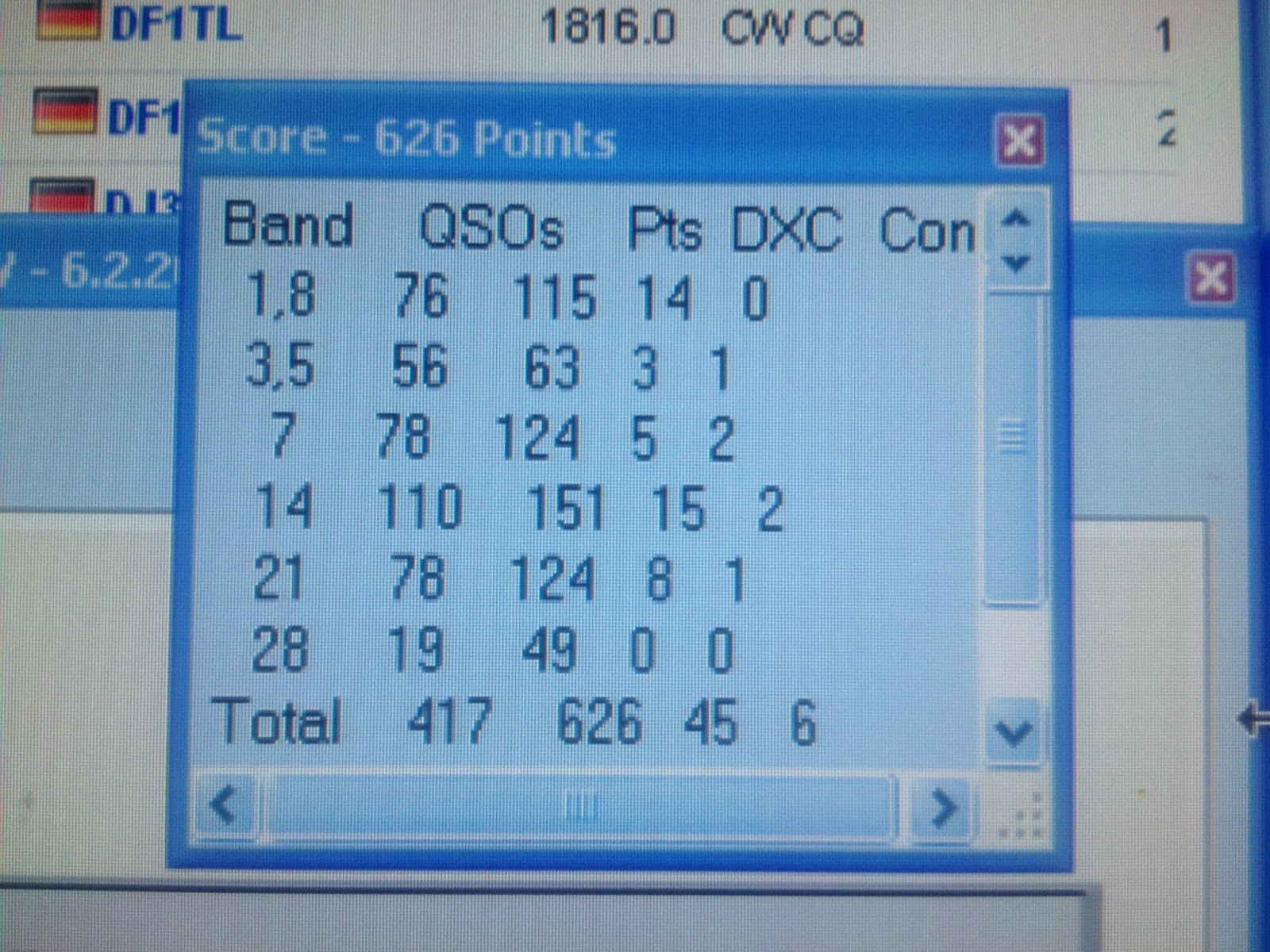
I would like to thank to all folks for nice QSO in FOC Marathon this year.

I participated this year in "No antennas" category… After wind storms in the past all my antennas are destroyed. Due to my health and familly issues I was not able to repair them till now. So I used just temporary installed wires and 5.3m pipe as vertical. So sorry for my pipsqueak signal on 80/40m. Even athough I was not able to sit on key for full time (my health is still not allowing me to sit longer then 20-30mins) it was funny event.

The conditions sounded strange on 10m in my QTH (because of no antennas for sure) all the weekend. An interesting openning I noticed on 10m Sunday morning. Kangaroos friends came thru really strong on almost empty band!

Very nice and enjoying band was for me 160m this year where I installed again my external RX loop antenna thru the KD9SV front-end saver and it worked pretty well. This W2PM small Mini Diamond loop is compact, easy to built and cheap solution which can help a lot if you have nothing better for reception on TB.

                      View of W2PM's Mini Diamond loop

It is just 1.5m square wire loop with loading resistor and feedline transformer so it will fit anywhere even on balcony or inside of house attic. (but I am recommending to place it as far from house noise as possible)

There is several other more powerful RX antennas like Diamond/Flag/Delta loops, VE3DO loop, K9AY system etc. but this W2PM loop is cheap and easy to try. (let me know if you want to send more instructions and help)

The best but more complicate solution which need more space and effort in building is definitely 3-el. Hi-Z verticals array. It will fit to 15x15x15m triangle lot and it will be hard to beat I guess.

In that case this antenna allowed me to copy several stations from west coast of EU, UKs etc. which were on the noise level at my QTH and not readable on TX antenna.


Pros: Jean, 5T0JL on 20m; Steve, VK7CW on 10m.

Cons: I did not worked Finn, HS0ZLM and Prasad, VU2PTT. Prasad's sigs on 40m last nite was incredible strong!

Best surprise: Gary, ZL2IFB came on 40m with amazing S9 sig even on my low apex wire.
 
 
My K3 worked flawlessly and I enjoyed all filters performance. I digged out (after years on shelf) the box with DTS-4/DTS-4R antenna switch. So I was able to connect wires and vertical to K3 thru switch together to be able to QSY thru all bands in second. Nice feature... just need to repair antennas, hi.


Many thanks for QSO to all friends.


161 - Petr, OK1RP

02 February 2016

Morse Telegraph History by Ian Poole, Electronics-radio.com

Hi all,

It is almost 60 year ago when the old RM-31 Morse hand key was made for the Czechoslovakia military (CSLA) radios. The first radio station where this key was used the RM 31 (Super Tana) was developed in 1952 so the key could be dated into 50's but commonly used and known is the key with later radiosets from 60's. This key is known as the RM-31 Telegraph Key (Telegrafni klic RM-31 in Czech language). These are the most pleasant hand keys to use and they are extremely well made.


An interesting comparison is with the small, rugged morse key developed for military in UK. This is special forces key which was used in PRC-320 radio-set known from Battle of Falklands Isl. in 80's. The SAS troops used this small and heavy rugged key mainly in hands or mounted on the legs.


It seems funny to compare them to modern touch-paddles... new fashion using an electronics and non-moving fingerboards quite often with electronic morse keyers implemented.


But back to the history of the Morse Telegraph, keys, bugs etc.

I do not like to re-posting an articles from different web pages but I found this very interesting article about the...

 Morse telegraph history Morse keys development Vibroplex & mechanical bug keys Telegraph sounder Morse inker Samuel Morse Fascinating facts  

It is writen by Ian Poole, Editor / Owner of Electronics-Radio.com and with his kind permission I am sharing over here short intro following by full link to the original source.

***

Morse keys, the Morse Code and the associated Morse telegraph system may seem outdated now but they revolutionised World communications and enabled messages to be sent almost anywhere very quickly.
Prior to electrical forms of communication it took many weeks for messages to be sent to the other side of the world. Australia was a very remote outpost of the British Empire for example. However with the introduction of the Morse telegraph system all this changed.
Messages could be sent quickly and efficiently in Morse code and as a result the system expanded very quickly enabling remote or outlying areas to be linked to the centres of civilisation.

Morse has an idea

All this started with an idea that dawned with Samuel Morse when he was returning from a trip to Europe. He was an eminent artist, but with a keen interest in the developing sciences, he had visited Europe to further his understand of the styles used their. On his return by ship he had plenty of time, and discussions took place on the ship. Out of these discussions ideas started to dawn in Morse's mind for an electrical communication system.
After his return, progress on developing his ideas for a communications system were slow. Eventually he enlisted the help of others including a man named Alfred Vail, a gifted mechanic. Progress became much faster and by 1838 they developed a system using dots and dashes to represent letters. Next they needed to secure funding for a trial system. This proved to be very difficult to achieve and the team Morse had brought around him drifted away. Nevertheless Morse was undeterred by the lack of interest, and he continued without most of his other partners. Finally he succeeded in securing funding to develop and install a trial 65 km line between Washington and Baltimore. It was completed in May 1844 and on 24th May Morse sent the first message "What hath God wrought!". The content of this message was chosen from the Bible (Numbers Chapter 23 vs 23) by Annie Ellsworth the young daughter of a good friend.


Diagram of early 'Correspondent' Morse key

After the successful demonstration of this first line people quickly realised the value of the new system and its use spread very rapidly. Within a year many new companies came into being to run lines to all parts of America. New lines were installed, often along side railroad tracks. This enabled the railroad companies to keep in contact with trains and by knowing where trains were and whether there were any delays they could use the single lines that were installed more efficiently. It was also found that towns that had been isolated now had communications links with the outside world. Previously communications relied on stagecoaches or the Pony Express, requiring days or weeks to cross the whole of the USA. In fact so successful was the Morse telegraph that only 19 months after the Pony Express was started it had to be discontinued.


A camelback key
The combination of key and sounder one a single base was known as a KOB (Key On Base)

Not only was the Morse system used in the USA, Europe and the rest of the world used it because of its effectiveness and simplicity. The first European line was set up between Hamburg and Cuxhaven in 1847, and many others quickly followed suit. Soon the need to link countries across seas and oceans was realised and in 1866 a submarine cable link was established between Britain and the USA, and by 1872 a link to Australia was established.
As a result of the vast use of the telegraph, stations were set up in towns, and in many remote areas repeater stations were required. Often new towns arose as a result of these. One famous example is Alice Springs in the Middle of Australia. Here a line was required from Adelaide in the South to Darwin across the centre of Australia so that messages could be sent to Darwin where an underwater line enabled messages to be sent to London. Alice Springs was one of several repeater stations required across Australia and it was located near a suitable pass in the McDonnell range of mountains. The town was near some water springs and it was named after the wife of Sir Charles Todd who erected the line.

Recent image of the centre of Alice Spings Australia - a town that started life as an Morse telegraph relay station.
The centre of Alice Springs today

Changes

Many changes occurred as a result of the introduction of the Morse telegraph system. Not only did it enable outlying towns and villages to keep in contact with the outside world, but it also meant that information reached its destination far more quickly. This meant changes in many areas of life. The stock markets that previously only had access to information that was weeks old now received information that was hours old. Practices had to change to take account of the fact that up to date information was received.
The speed at which information could be sent meant that many areas of life started to speed up. At war up to the minute intelligence was of paramount importance and in the American Civil War, many telegraph operators were in the front line to send back vital information. The bravery of many of these operators was outstanding, but as they were not in the Army, none received any gallantry awards.


A steel lever key

The telegraph was also used to carry back the information about the end of the Civil War. After General Grant accepted the surrender of General Lee on 9th April 1865, he sent the message: "General Lee surrendered the army of Northern Virginia this afternoon on terms proposed by myself the accompanying additional correspondence will show the conditions fully".

Wireless and Morse

The Morse code was widely used for wireless transmissions, especially in the very early days when it was not easy to modulate a signal to carry sound. As a result many historic transmissions were made using Morse code. One was the first transatlantic radio transmission made by Marconi on 12th December 1901. This made headline news on both sides of the Atlantic.
Some years later another incident of major importance occurred. In 1912 during the maiden voyage of the Titanic, the liner steered a northerly course to shorten the distance travelled to try to make a record breaking crossing. Unfortunately she struck an iceberg on the night of 14th April and although she had been declared unsinkable, the great liner rapidly took on water and sank. The two wireless officers sent out the distress signals. Alas the wireless operator on the nearest ship was asleep and did not hear the call. However the distress signals were heard on both sides of the Atlantic as well as by the SS Carpathia that was about 93 km away. As a result Carpathia steamed towards the stricken liner only to reach the area an hour and twenty minutes after Titanic sank. Fortunately around 700 souls were rescued, but over 1500 people died in the tragedy.

Recent times

The development of communications systems did not stand still and as a result the use of Morse has declined considerably in recent years. The introduction of the teleprinter spelt the end of the use of Morse over landlines. Using the teleprinter it was possible to use a keyboard to enter messages, and a printed copy was provided at the far end. In Britain the Post Office discontinued the use of landline Morse in 1932, although in the USA and Australia its use continued until the 1960s.
The use of Morse over the radio has continued for many years after this particularly for ships. However the use teleprinters and then computers combined with the growing use of satellite communications meant the end for Morse. Finally from midnight on 31st January 1999, international regulations no longer required ships at sea to be able to make distress calls in Morse.
Despite this some ships, especially those from the third world still use it as a low cost alternative to the more expensive satellite systems. Also radio amateurs still use it widely because it offers advantages in terms of the simplicity of the equipment and being able to make contact under conditions when other forms of communication would not be able to get through. As a result its use will continue for many years to come, continuing a tradition that is over 150 years old.

***
 
The complete article you can find here: